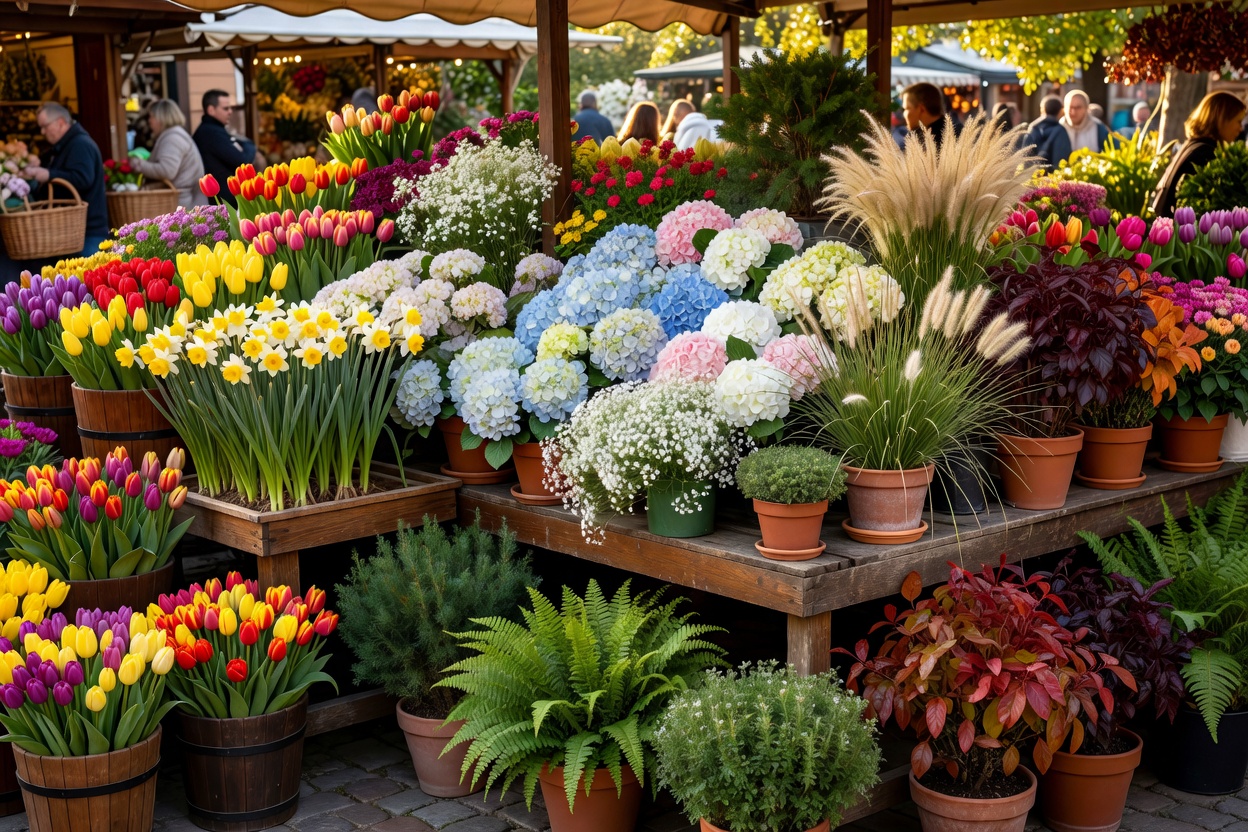
1. Northern Europe: Scandinavia and the Baltic Basin
Northern European markets rely on heated greenhouse infrastructure and heavy import flows. Winter daylight limitations restrict domestic field harvesting from November through March. In response, markets focus on indoor potted flora, forced spring geophytes, and hardy conifers.
Outdoor market plazas (e.g. Helsinki’s Kauppatori or Stockholm’s Hötorget) operate in open air primarily between May and September. During sub-zero winters, cut stems cannot withstand unheated exposure. Trading transitions indoors to enclosed saluhallar where temperature-regulated glass cases protect stem tissue from cell rupture.
2. Western Europe: The Atlantic Supply Core
Western Europe represents the global nerve center for flower logistics. The Netherlands, Belgium, France, and the UK possess dense auction hubs, roll-on/roll-off maritime transport, and specialized logistics corridors.
Stall culture is design-led and trade-heavy. City markets operate alongside high-end florist districts. Wholesale facilities conduct electronic bidding in the pre-dawn hours. Stems arrive at urban flower markets before 06:30 AM via refrigerated sprinter vans. Inventory includes both local greenhouse crops and stems flown into Schiphol airport from Kenya, Colombia, and Israel.
3. Central Europe: Continental Traditions
Germany, Austria, Switzerland, and Poland balance municipal wholesale Grossmärkte with open-air weekly Bauernmärkte. Seasonal weather shifts are pronounced: cold winters require indoor hall layouts, while warm continental summers encourage expansive outdoor displays.
Markets place a strong priority on regional seasonality and potted garden perennials. German market stalls enforce precise origin labeling (Regionalfenster) that distinguishes domestically grown field crops from imported wholesale goods.
4. Southern Europe: Mediterranean Outdoor Culture
Southern Europe (Spain, Italy, Greece, Portugal) benefits from high solar radiation and mild winters. Outdoor market squares operate continuously through all twelve months.
Key trading hubs include the Campo de' Fiori in Rome, the Mercado de las Flores in Valencia, and the flower kiosks of Las Ramblas in Barcelona. Summer temperatures present a severe logistical challenge: daytime heat often exceeds 32°C by midday. To protect stem integrity, trading starts at 06:00 AM and winds down by 13:00 PM. Retail displays utilize frequent water misting and canvas shade canopies.
5. Eastern Europe: Urban Kiosks & Field Production
Eastern European floral distribution (e.g. Poland, Czech Republic, Hungary, Romania) combines state-of-the-art logistics terminals with networks of permanent 24-hour urban street kiosks.
Municipal street kiosks are positioned outside metro stations and transit interchanges. They trade single stems and hand-tied bouquets continuously. In rural fringe zones, seasonal grower markets allow smallholders to sell field-grown peonies, lilacs, and dahlias straight from open truck beds during peak summer harvest.
Regional Comparison Grid
| Region | Peak Trading Window | Dominant Facility Type | Supply Origin | Major Climate Hazard |
|---|---|---|---|---|
| Northern Europe | 08:00 – 16:00 (Summer) | Heated Halls / Enclosed Stalls | Dutch Import / Local Hothouse | Freezing air rupture |
| Western Europe | 05:00 – 12:00 | Covered Wholesale / Historic Plazas | Domestic Auction / Global Cargo | High humidity mold |
| Central Europe | 06:30 – 13:30 | Municipal Grossmärkte & Town Squares | Mixed Regional & Import | Late spring ground frosts |
| Southern Europe | 06:00 – 13:00 | Open-air Street Markets | Local Coastal Farms & Shippers | Midday thermal wilting |
| Eastern Europe | Continuous / 24h Kiosks | Transit Stalls & Direct Trucks | Local Smallholder & EU Wholesale | Winter cold snaps |
Good for
- Targeting seasonal specialty crops unique to specific geographic microclimates.
- Optimizing market arrival times based on regional trading customs.
- Selecting regions aligned with personal botanical sourcing goals.
What to know
- Southern European markets close substantially earlier than Northern European stalls due to midday thermal stress.
- Cash payment remains essential for smallholder producers in Southern and Eastern European markets.
- National bank holidays frequently suspend market operations without advance notice on digital maps.